
When hormone therapy becomes harm — and what every patient deserves to understand before starting treatment.
Testosterone is a naturally occurring hormone produced in both men and women. In the body, it can influence energy, mood, libido, bone density, and muscle development.
It is also a powerful anabolic-androgenic steroid. While your body produces testosterone endogenously, it can also be introduced exogenously through injections, pellets, creams, patches, gels, and other delivery methods.
When used appropriately under careful medical supervision, testosterone can be clinically indicated for specific conditions. But when it’s broadly prescribed, aggressively marketed, or used outside clear medical necessity, it may disrupt the brain and body in ways many patients are never warned about.
The distinction between what your body produces naturally and what is administered externally is not minor — it can be medically significant.
Endogenous: produced naturally by the body.
Exogenous: introduced from outside the body.
Anabolic-androgenic steroids: synthetic or administered hormones related to testosterone that can impact tissue, mood, and behavior.
This page does not provide medical advice. If you have concerns about hormone therapy, consult a qualified medical professional.
In 2009, Lisa was told she was a candidate for testosterone replacement therapy. What began as a medical intervention evolved into a multi-year dependency that destabilized her mental health and nearly cost her life.
What she experienced was not weakness. It was a physiological and neurological response to a powerful hormone administered without adequate risk transparency.
Her recovery became her advocacy. Today, she speaks openly about what is often left out of the conversation — not to shame, but to educate, protect, and empower informed decision-making.
Lisa presents on testosterone trauma, iatrogenic addiction, and the intersection of hormone therapy and mental health to:
Her presentations combine lived experience, neuroscience education, clinical awareness, and trauma-informed perspective.
This is not a sensational talk.
It is a grounded, research-informed, patient-centered conversation.
Not ready to book yet? Learn more or explore upcoming events.
A brief 30-minute conversation to discuss your audience, goals, and event details.
Prefer email? lisashaughnessy@outlook.com
Testosterone levels and “normal ranges” are frequently debated — and patients can receive wildly different guidance depending on the clinic, the lab, and the business model behind the recommendation.
Before starting therapy, it’s reasonable to ask for clarity: What is the clinical indication? What are the risks? What is the plan to monitor mental health outcomes? What happens if you stop? What does dosage escalation look like — and why?
In medicine — more is not always better. Patients deserve clear information before they agree to powerful interventions.
Discontinuing testosterone and anabolic-androgenic steroids can be physically and psychologically difficult for some individuals. Healing may involve medical supervision, behavioral health support, and trauma-informed care.
Recovery is not one-size-fits-all. It can include different levels of care depending on dosage, duration, method of administration, co-occurring conditions, and the presence of other process or substance dependencies.
Healing is not linear — but it is real. With the right support, people can regain stability, rebuild trust in their body, and move forward.
For expanded education, research, and recovery information, visit the comprehensive resource hub:
External link opens in a new tab.
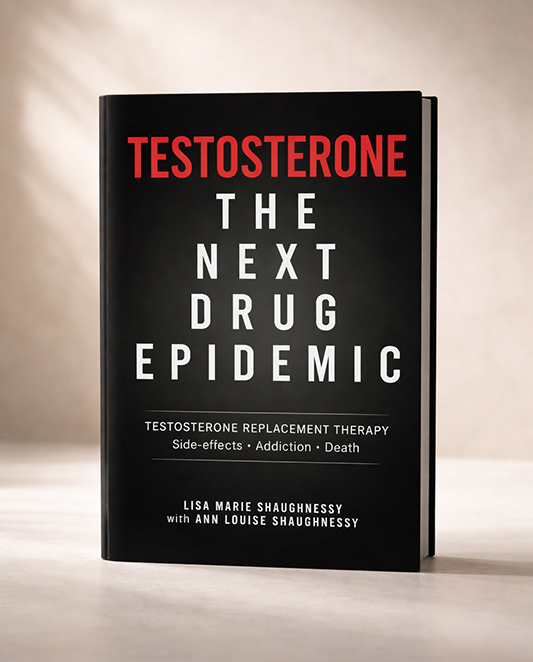
A powerful exploration of the largely unspoken risks of testosterone replacement therapy—side effects, addiction, and death— grounded in science, lived experience, and compassion.
“People are being led to believe they need testosterone. They don’t.”
What they don’t know is they may be embarking on a hormonal roller-coaster ride that can change everything.
Award Recognition: Taylor Hooton Legacy Award (Advocacy & Education)
Whether you’re seeking deeper education on testosterone trauma or exploring this topic for a professional audience, there are two clear paths forward.
Access expanded research and recovery resources — or bring this critical conversation to your organization.